How The Ascott Limited Achieved 41% Brand Revenue Growth Using Intent-Driven Search Themes in Performance Max for Travel Goals
The Ascott Limited manages a portfolio of more than 1,000 properties across over 40 countries, driven by a vision to be a preferred hospitality company. With Southeast Asia among its fastest-growing markets, the brand turned its focus to Malaysia to sharpen its digital performance marketing, prioritizing acquisition efficiency and brand-level performance in a market central to its regional growth.
The Challenge
In Malaysia, The Ascott Limited had to progress on three priorities:
- Driving more brand-attributed bookings.
- Improving acquisition efficiency.
- Reaching high-intent travelers across a diverse, multi-brand portfolio.
Individually, each goal is straightforward, but achieving them in combination required a more structured and deliberate approach to campaign setup and optimization across all brands..
The Approach
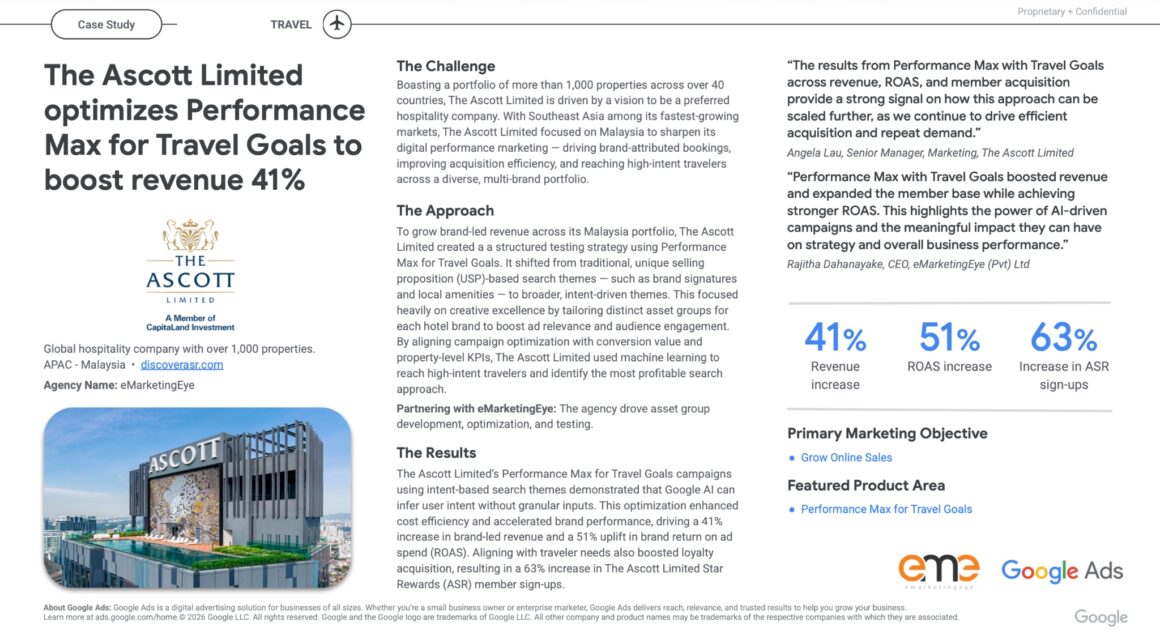
To grow brand-led revenue across The Ascott Limited’s Malaysia portfolio, eMarketingEye built a structured testing strategy using Performance Max for Travel Goals (PMTG). This meant moving away from traditional, USP-based search themes built around brand signatures and local amenities. In their place, broader, intent-driven themes were introduced. The goal was to help Performance Max identify and reach high-quality, high-intent audiences more effectively.
Creative excellence was a key pillar of the approach. Separate asset groups were developed for each brand to improve ad relevance and engagement, ensuring that the move toward broader intent signals did not dilute individual brand identity.
Campaign optimization was aligned with conversion value and brand-level KPIs, allowing eMarketingEye to leverage machine learning to reach high-intent travelers and identify the most profitable search approach.
The Results
The Ascott Limited’s Performance Max for Travel Goals campaigns, leveraging intent-based search themes, showed that Google AI can effectively interpret user intent without highly granular inputs. This optimization improved cost efficiency and accelerated brand performance, resulting in:
+41% increase in brand-led revenue
+51% uplift in brand return on ad spend (ROAS)
+63% increase in member sign-ups (Ascott Star Reward)
That last figure matters as much as the revenue gain. Aligning campaigns more closely with traveler needs didn’t just improve short-term bookings, it boosted loyalty acquisition, a sign that broader intent-based targeting was reaching the right travelers, not just more of them.
What It Signals
The Ascott Limited case study highlights a broader evolution in search theme optimization: highly granular, USP-by-USP targeting is not always the most effective approach. With strong conversion signals and well-structured asset groups, Google AI can surface relevant travelers based on intent alone, often outperforming narrowly defined, manually built segments.
For multi-property, multi-brand portfolios in particular, this changes the game. Instead of mapping multiple unique selling points to audience segments, brands can build strong creative foundations and let machine learning match them to the travelers most likely to book, and become loyal members.
Reaching the right traveler for the right property is increasingly a question of trusting the right signals, not just crafting the perfect list of keywords or search themes.